




Dutch payroll in 2026 is not difficult because of one dramatic new rule. It is difficult because several moving parts meet in the same payslip: a mid-year minimum-wage increase, tax-free allowance limits, contractor classification, commuting data and legislation that takes effect at the end of 2026 or later.
For payroll teams, the safest approach is to separate three things: what applies now, what changes during 2026, and what belongs in the 2027 or 2028 roadmap. This guide does exactly that.
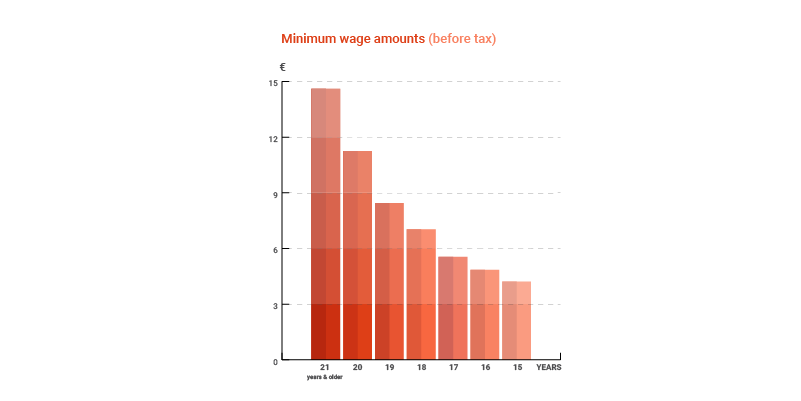
Dutch Minimum Wage Increase 2026
The Government of the Netherlands has announced that starting from January 1, 2026, the Dutch minimum wage has increased to €14.71 per hour for employees aged 21 and older. This mandatory adjustment applies across all industries, regardless of collective bargaining agreements (CAO).
Implementation Requirements:
Immediate Payroll Updates: Verify your payroll system reflects the new wage rates.
Compensation Review: Analyze your entire salary structure to maintain internal equity.
Budget Planning: Incorporate increased labor costs into your 2026 financial projections.
1. Build payroll on the correct worker and employer data
Before calculating gross-to-net pay, confirm the legal employer, contract type, working pattern, tax residence, social-security position and whether a collective labour agreement (CAO) applies. A correct formula built on the wrong classification is still the wrong payroll.
For each employee, payroll normally needs identity and address details, a signed payroll-tax declaration, a valid BSN, bank details, contractual salary, hours, allowances and benefit selections. International employees may also have an A1 certificate, immigration conditions or an expat-scheme decision that changes the treatment.
Do not use the 30% facility merely because an employee is foreign. The employer and employee need an eligible situation and a decision from the Dutch Tax Administration.
2. Apply the 2026 minimum wage at the right date
For employees aged 21 and over, the statutory hourly minimum wage is €14.71 from 1 January through 30 June 2026. It increases to €14.99 from 1 July 2026. Youth rates apply below age 21.
That mid-year change should be treated as a payroll event, not just a rate-table update. Check employees paid close to the threshold, hourly equivalents of fixed salaries, overtime and allowance calculations, and any salary scales linked to the statutory amount. A CAO can require a higher rate.
Employees are also generally entitled to holiday allowance of at least 8% of gross annual pay. There are exceptions and written arrangements for higher earners, and a CAO may contain more favourable rules. Make sure the accrual basis matches the contract and applicable CAO.
3. Use tax-free allowances only when the conditions fit
The targeted exemption for working from home is €2.45 per day in 2026. It is not simply an automatic net payment. The employer needs a defensible working pattern and should avoid applying both the home-working allowance and a commuting allowance for the same day unless a specific rule permits the combination.
The expat scheme can still provide a tax-free allowance of up to 30% of qualifying remuneration in 2026. The remuneration cap used for the scheme is €262,000 for 2026. For employees who entered the scheme from 2024, the maximum percentage is scheduled to fall to 27% from 1 January 2027. Transitional rules preserve the 30% maximum for certain employees whose scheme already applied before 2024.
That makes late 2026 a good moment to model 2027 net pay, employer cost and any gross-up commitment. Do not wait until the January payroll to discover that the employment contract promised a net result the tax rules no longer support.
4. Treat Wet DBA enforcement as normal operations
In 2026, the Dutch Tax Administration applies the normal enforcement rules against false self-employment. In practice, an engagement labelled “freelance” can still qualify as an employment relationship when the actual working arrangement meets the relevant legal criteria.
Corrections and additional payroll-tax assessments can be imposed retroactively within the applicable enforcement framework. In 2026, the Tax Administration does not impose default penalties for this enforcement, although culpability penalties can apply in cases involving intent or gross negligence. The absence of a default penalty does not remove potential tax, interest, employment-law or pension exposure.
5. Prepare for the new low-rate presumption
A rebuttable legal presumption of employment takes effect on 31 December 2026. The enacted Civil Code provision uses a €36 hourly baseline, but the first operational amount is to be set by ministerial regulation. Current public guidance has often referred to a €38 threshold.
The practical message is clearer than the final number: engagements around the threshold need a documented review before year-end. The presumption affects the evidential position when a worker claims employee status; it does not automatically convert every invoice into a payslip. Confirm the ministerial amount in force before implementation.
6. Keep WPM reporting on the current legal footing
Under the Work-related Mobility of Persons reporting regime (WPM), organisations with 100 or more employees currently have annual reporting duties for business travel and commuting. Annual data must be submitted by 30 June of the following year.
A proposal would exempt organisations with fewer than 250 employees, potentially with retroactive effect from 1 January 2026. As checked on 14 September 2026, the official RVO guidance still applies the 100-employee threshold and states that the change is not yet in force. Employers with 100–249 employees should therefore continue collecting the required data until the rules formally change.
Payroll may not own the full WPM submission, but it often holds the commuting allowances and workforce counts needed to reconcile it. Agree ownership between payroll, HR, finance and facilities.
7. Put the flex-worker changes on the correct timeline
The More Security for Flex Workers Act has been enacted, but most headline contract changes do not apply in 2026 or 2027. The core provisions—including bandwidth contracts replacing zero-hours-style on-call arrangements and a longer interruption before a new chain of fixed-term contracts—start on 1 January 2028.
Parts concerning equal employment conditions for agency workers take effect on 31 December 2026, with other agency-worker provisions following on 1 January 2027. Employers using staffing agencies should therefore review supplier and pay-parity data earlier than employers whose only concern is their own on-call contracts.
This distinction matters. “A new law has passed” is not the same as “every provision belongs in this month’s payroll”.
8. Close each payroll with a compliance trail
A reliable Dutch payroll close should leave evidence of:
Approved starters, leavers, salary and hour changes
Current tax declarations and expat-scheme decisions
Minimum-wage and CAO checks
Reconciled taxable and tax-free allowances
Contractor and agency-worker reviews owned outside payroll
Payslip-to-payment and payroll-to-ledger reconciliation
Submitted payroll-tax return and payment deadlines
Corrections documented with an owner and effective date
The best control is rarely another spreadsheet. It is a clear source of truth, a cut-off that managers respect, and somebody authorised to resolve exceptions before pay day.
How Unusual Payroll supports employers
Unusual Payroll helps international employers translate Dutch rules into repeatable payroll operations—from employee onboarding and monthly calculations to HR coordination and compliance support. The service can also support an Employer of Record route when a company needs to employ in the Netherlands without immediately establishing its own local entity.
The right model depends on headcount, permanence, immigration needs and control. An EOR can simplify the employing infrastructure; it does not remove the client company’s responsibility to give accurate instructions or run the day-to-day working relationship responsibly.
This article is general information, not legal or tax advice. Payroll treatment depends on the facts, applicable CAO and current official guidance.
What is the minimum wage in the Netherlands in 2026?
For employees aged 21 and over, the statutory minimum hourly wage is €14.71 from 1 January through 30 June 2026 and €14.99 from 1 July. Lower youth rates apply to employees under 21. A collective labour agreement may require a higher wage.
What should employers review under the renewed worker-classification enforcement?
Employers should review freelancer and ZZP agreements, clearly document roles and responsibilities, and verify that independent-contractor relationships meet the applicable legal criteria.
Did the WPM reporting threshold increase to 250 employees in 2026?
Not yet, based on the official position checked for this guide. A change has been proposed that would exempt organisations with fewer than 250 employees, but RVO still applies the 100-employee threshold. Organisations with 100–249 employees should continue collecting the required data until the change formally takes effect.


