

An Employer of Record (EOR) employs the worker through its own legal entity, while the client directs the daily work. A Professional Employer Organization (PEO) usually supports a business that remains the employer. For Dutch hiring, the actual employment contract and legal arrangement determine responsibilities; the service name alone does not.
Consider two businesses reviewing proposals. One has found a candidate in the Netherlands but needs an organisation to employ that person. The other already employs a Dutch team and wants help with payroll and HR administration. Both need support, but changing the employer solves a different problem from improving the administration.
What are the benefits of Employer of Record and Professional Employer Organization?
Employer of Record
In an EOR arrangement, the provider’s employing entity enters into the employment contract with the worker. The client normally selects the candidate and manages the work, while the provider performs the employer functions required by law and the agreement. This can allow a business to hire without first establishing its own Dutch employing entity.
In practice, that means turning an agreed job offer into a workable employment arrangement. The client supplies the role, hours, location and proposed package; the provider checks the employment terms, prepares the contract within its agreed scope and sets up payroll. Where Dutch payrolling rules apply, the client must also supply the relevant comparable employment conditions. Salary processing cannot safely be separated from those inputs.
Before the start date, agree who collects employee details, answers contract questions and confirms that payroll has the approved information. The client then directs the work, while the provider handles the agreed employer-side administration. A named contact and a clear route for changes make that division usable day to day. Our EOR guide explains the underlying model.
Professional Employer Organization
A PEO provides employment-related support, often including payroll, benefits and HR administration. The term is associated particularly with the United States, where co-employment arrangements divide specified functions between the client and provider. Even there, legal and tax responsibilities vary with the arrangement, as the US tax authority’s PEO guidance explains.
That terminology cannot simply be imported into Dutch law. Some providers use “global PEO” for a service that functions as an EOR. Others use it for support to a business that remains the employer. Ask who signs the employment contract and under which legal arrangement the person works. The answer tells you more than the product label.
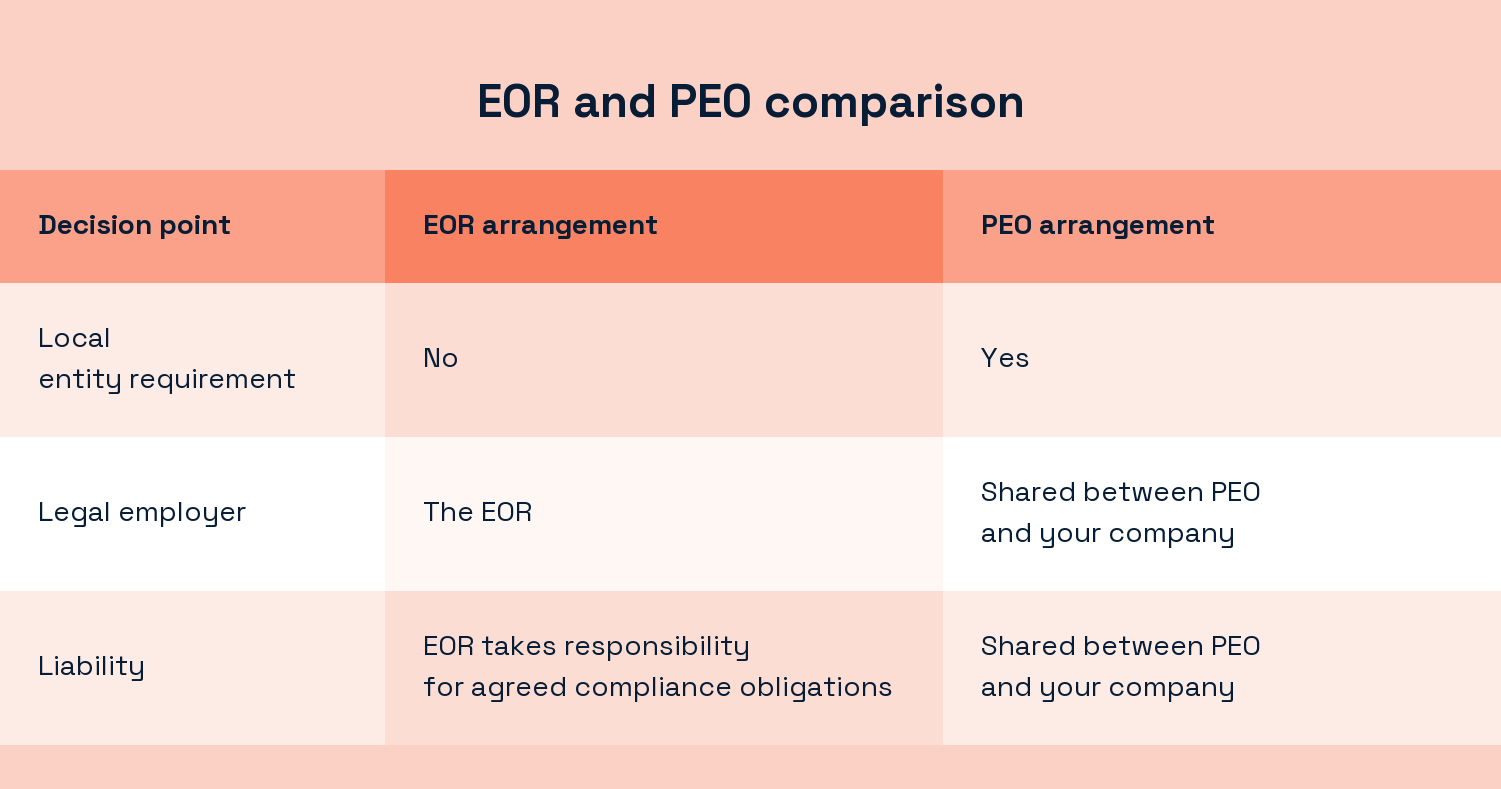
The table compares operating models, not every service sold under these names. If a proposal describes shared employment, ask the provider to explain the legal basis in the Netherlands and its consequences for your business and the employee.
How does Dutch payrolling compare with EOR and PEO?
In the Netherlands, payrolling can mean an employment arrangement in which a payroll company is the formal employer while the client recruits and supervises the worker. That is different from outsourcing salary calculations for people who remain employed by the client.
Where the arrangement qualifies as payrolling, specific protections apply. Payroll employees are entitled to the relevant employment conditions available to comparable employees of the client, with statutory pension rules also applying. Dismissal protections cannot be avoided by ending the commercial relationship. The government’s payrolling guidance explains the framework.
The classification follows the contracts and the facts. An international EOR label does not make Dutch payrolling rules irrelevant, and calling a service “payroll” does not establish that the provider will employ anyone. Clarifying this early prevents two proposals with similar descriptions from being treated as equivalent.
Which responsibilities stay with the client under an EOR or PEO arrangement?
The client controls important parts of the employee’s working life: assignments, working hours, management and the workplace. The provider needs accurate information about those matters to fulfil its role. For example, a change in duties or hours can affect employment conditions and payroll; it should not reach the legal employer only after the change has taken effect.
Consider a manager agreeing that an employee will move from four days a week to five. The client confirms the proposed hours, salary and effective date; the EOR checks and documents the employment change with the employee and arranges the payroll update. Ask how the provider handles the request, who approves the final figures and what happens if it arrives after the payroll cut-off. Without that coordination, the manager’s agreement and the employee’s payslip can tell different stories.
The same need for a defined process applies to safety, sickness reporting and performance concerns. The client cannot hand over responsibility for the workplace simply because another entity signs the contract. Agree how managers report an issue, when the employer must become involved and who explains the next step to the employee.
Financial exposure is another consideration. Dutch hirer-liability rules can make a client liable for unpaid payroll taxes in relevant staff-supply arrangements. An indemnity allocates costs between the contracting parties; it does not remove the authority’s statutory powers or the employee’s rights.
Check the provider’s staff-supply registration with KVK, the Dutch Chamber of Commerce. Also ask how the arrangement will meet the forthcoming Wtta admission requirements. The government’s published timetable puts the law’s start in 2027 and enforcement in 2028. Registration is a check to make, not a guarantee that every aspect of a proposal complies.

When should you consider an EOR or PEO in the Netherlands?
An EOR is worth exploring when you need a legal employer for a Dutch-based employee and do not have a suitable setup of your own. It can support a defined market-entry period or an ongoing arrangement, depending on the role and the contracts. It is not inherently a product for temporary workers or a particular minimum team size.
Payroll or HR support is a different starting point when you already employ the team. If the problem is administration, there may be no reason to change the employer. Define the missing support first: salary processing, leave administration, employment documentation or coordination across those tasks.
Direct employment through a foreign business is another possibility that deserves assessment. A Dutch BV is not the only alternative to EOR; a foreign employer can have Dutch payroll-tax obligations without forming a subsidiary. Our guide to hiring without a Dutch entity develops that decision.
How should you compare EOR and PEO costs?
A meaningful comparison starts with the same employee package. Ask for salary, holiday allowance, employer charges, pension, insurance and the provider’s service fee to be shown separately. Add deposits, onboarding charges and any costs excluded from the monthly price. Then establish what happens during sickness, a contract change or an exit.
This matters because the cheapest visible fee is not necessarily the lowest total cost. One provider may include work another bills separately; the two offers may also allocate longer-term employment costs differently. Neither EOR nor PEO is automatically cheaper. If the wider decision is whether to run your own employing entity, our EOR-versus-direct-entity analysis addresses that separate comparison.
Before committing, obtain written answers to four questions:
Which exact legal entity will employ the worker?
Which decisions remain with us, and which require the employer’s involvement?
Which costs and responsibilities are outside the quoted fee?
What happens to the employment relationship when the service agreement ends?
Choose EOR or PEO support around your Dutch hiring needs
Start the provider discussion with a real hiring need: the proposed role, work location, salary package, intended start date and any immigration questions. If you already employ the person, say which tasks need support. Ask the provider to walk through the first month, from agreed terms to the first payslip, and explain how a later change would be handled. That reveals more than a list of services.
Unusual Payroll offers EOR services and Dutch payroll and HR support. Discuss the employment setup you need with the team: a legal employer for a new hire, or administrative support for an existing team. Confirm the employing entity, the work included and the responsibilities that stay with your business before agreeing the arrangement.
Can we dismiss an employee by ending the EOR agreement?
No. Ending the commercial service agreement does not automatically end the employment contract. The applicable dismissal rules, notice requirements and payment obligations still matter. Ask the provider to explain the process and cost allocation before signing, including what happens if your business no longer has work for the employee but the employment relationship continues.
Is every EOR an IND-recognised sponsor?
No. EOR is a service description, not recognition by the Dutch Immigration and Naturalisation Service, IND. Check the exact employing entity in the official register. It lists Unusual People B.V., KVK 70658188, as a recognised sponsor. Recognition does not mean that every candidate, role or proposed working arrangement qualifies for a residence permit.
Does an EOR remove permanent-establishment risk?
No. The employment model does not by itself determine whether your Dutch activities create a taxable presence. The employee’s actual work and authority, alongside the wider business arrangements, may need separate tax analysis. A provider’s commitment to process payroll should therefore not be treated as a conclusion about your company’s corporate-tax position.
Can an EOR employee report to managers outside the Netherlands?
Yes, overseas reporting lines can form part of the arrangement. Specify where the employee works, who supervises them and how equipment and working conditions are organised. If the person also works in other countries, assess those days separately, because cross-border work can affect tax, social security, employment rules and immigration permission.
Who owns the work and intellectual property that the employee creates?
The contracts and applicable law must establish the relevant rights. Paying a service invoice does not, by itself, answer every ownership question. Review the employment agreement and the client agreement together, including confidentiality and any necessary assignments, so that rights which must pass through the employing entity reach the party that needs them.
Can the employee later move to our own company?
Yes, a transition can be arranged where the contracts and applicable rules allow it. Coordinate employment terms, continuity of rights, payroll records, benefits and any immigration requirements before setting the transfer date. Moving away from an EOR is not simply a database change, and it should not be presented as an automatic reset of the employee’s existing rights.