As the Netherlands updates its immigration framework for 2026, salary requirements for highly skilled migrants (HSMs) are rising to keep pace with labor market shifts and inflation. These changes directly impact employers sponsoring international talent as well as professionals planning to enter the Dutch labor market. This article outlines the 2026 salary limits for highly skilled migrants, the updated IND thresholds, and what organizations must do to stay compliant under Dutch immigration law.
What Is the Highly Skilled Migrant Scheme in the Netherlands?
For companies operating internationally, the Highly Skilled Migrant (HSM) scheme is a key route to attract qualified professionals to the Netherlands. However, the system is highly regulated and closely monitored by the Immigration and Naturalisation Service (IND). As salary thresholds are indexed annually, employers and employees who are unfamiliar with the Dutch legal and commercial system often face uncertainty when preparing contracts, payroll structures, and visa applications. Understanding the 2026 updates is essential to avoid delays, rejections, or compliance risks.
By understanding why the Netherlands is a top destination for highly skilled migrants, you can make strategic decisions for your workforce sourcing.
Updated Salary Thresholds Under Dutch Immigration Rules
The IND requires employers to meet strict salary criteria when applying for or renewing HSM residence permits. These thresholds are established at a national level and apply across the board, regardless of sector or role. They are reviewed annually and adjusted to reflect the latest negotiated wage developments.
What’s Changing in 2026?
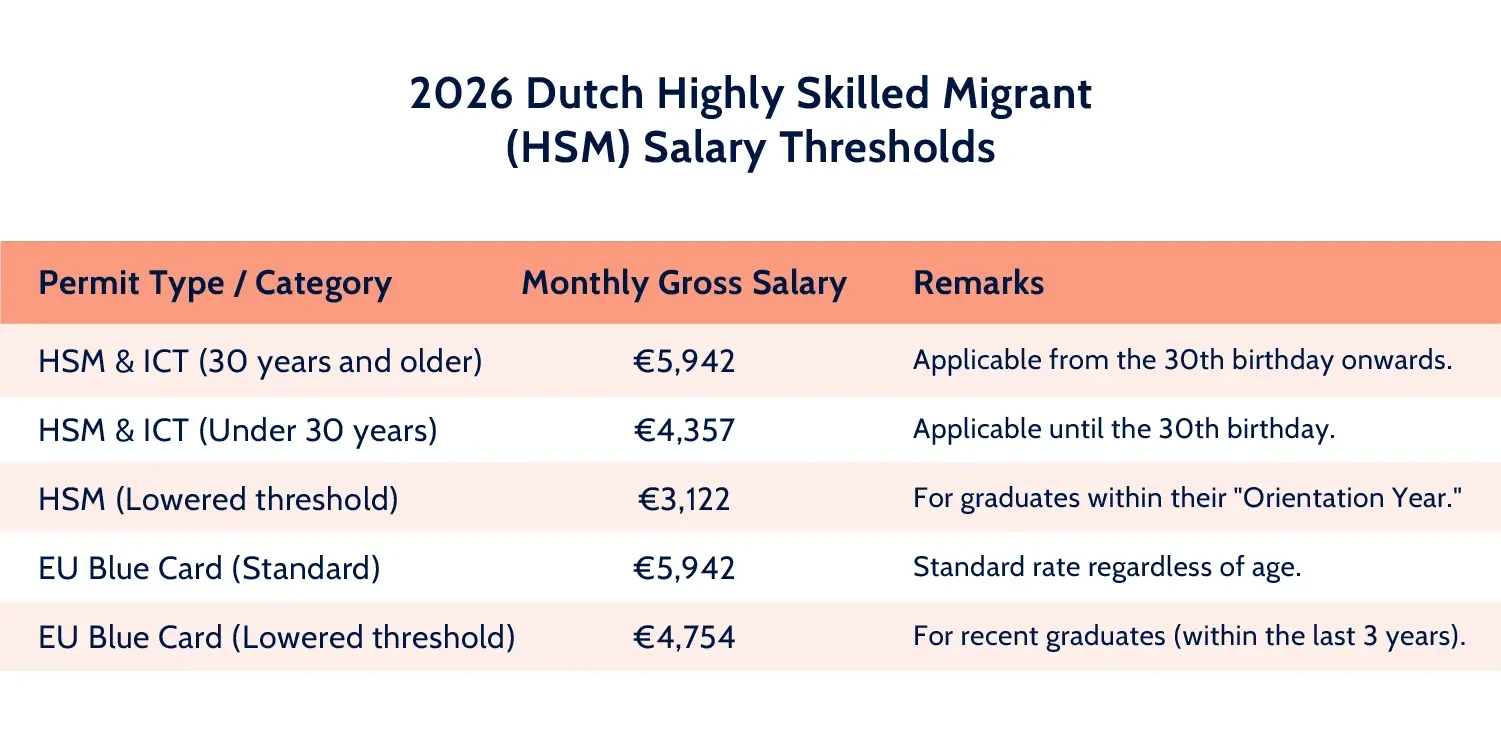
As of 1 January 2026, the gross monthly salary thresholds (excluding the 8% holiday allowance) are as follows:
Highly Skilled Migrants aged 30 and over: €5,942
Highly Skilled Migrants under 30: €4,357
Reduced threshold for recent graduates (orientation year or qualifying degree): €3,122
These figures represent the official 2026 highly skilled migrant salary limits and apply to all applications assessed in 2026, including extensions and changes of employer.
How the Thresholds Are Calculated
The IND salary threshold is based on fixed gross monthly income. Variable components such as bonuses, commissions, or non-guaranteed allowances generally do not count toward the threshold. Salaries must be paid monthly, in full, to the employee’s bank account. Employers must be able to demonstrate compliance through payroll records and bank payment evidence as part of IND compliance for salary payments.
Key Considerations for Employers and HR Teams
Meeting the salary threshold alone is not enough. Employers must also ensure that their payroll structure, documentation, and internal processes are fully aligned with immigration requirements.
Recognized Sponsor Status and IND Compliance
Only employers with recognized sponsor status are permitted to sponsor highly skilled migrants. While this status offers faster processing times, it also brings additional obligations. Employers are expected to actively monitor compliance, report relevant changes, and retain documentation that proves salary payments meet IND requirements.
From 2026 onward, the IND places increased emphasis on verifiable salary payments, meaning that payslips alone may not be sufficient. Bank statements or consolidated payment records may be requested during audits.
Salary Threshold vs. Statutory Minimum Wage
The statutory minimum wage vs HSM limit distinction is a frequent source of confusion. HSM salary requirements are significantly higher than the Dutch minimum wage and are designed specifically for immigration purposes. Even if an employee meets general labor law standards, failing to meet the HSM salary threshold can result in non-compliance.
Employers must therefore treat Dutch work permit salary criteria as a separate and higher benchmark when sponsoring international employees.
HSM Sponsorship Costs and Fees
In addition to salary obligations, companies should plan for HSM sponsorship costs, which may include:
HSM visa application fees
Costs associated with obtaining or maintaining recognized sponsor status
External legal or advisory support
Relocation costs and onboarding expenses
These elements are often overlooked during workforce planning but can significantly impact total employment costs.
The Role of Inflation and Indexing Salaries
Salary thresholds under the HSM scheme are indexed annually based on negotiated wage developments. The 2026 increase reflects the impact of inflation on HSM salaries and broader labor market trends in the Netherlands.
For employers, this means that salary compliance is not a one-time exercise. Ongoing salary adjustments may be required to ensure continued compliance, particularly for long-term employees whose salaries were compliant in previous years but fall below updated thresholds.
2026 Compliance Steps and Strategic Considerations
This section outlines the most important operational and compliance steps employers should review when preparing for the 2026 HSM salary thresholds. Addressing these points proactively helps reduce audit risks, prevent application delays, and ensure full alignment with IND expectations.
Confirm that gross monthly salary meets the applicable IND salary threshold
Ensure salary payments are executed correctly and remain fully traceable
Review ongoing obligations linked to recognized sponsor status
Accurately calculate net pay, including tax-free allowance structures
To gain deeper insights into hiring international talent, you may read our article titled 'Employing Highly Skilled Migrants in the Netherlands: A Comprehensive Guide.' This will enable you to develop the most effective strategic roadmap for your company’s growth.

Navigating the Dutch Legal Framework for Company Structures
The updated 2026 salary requirements for highly skilled migrants highlight the importance of aligning payroll execution, immigration compliance, and workforce planning in the Netherlands. Employers who understand the new thresholds, anticipate indexed increases, and maintain transparent salary documentation will be better positioned to sponsor international talent successfully while minimizing legal and operational risks.
Due to the complexity of Dutch regulations, professional support is utilized to ensure the security of administrative processes. With an experienced team, Unusual Payroll operates as a trusted EOR service provider for numerous companies in the Netherlands and beyond. The management of international talent and legal compliance processes are conducted meticulously within the scope of the firm's expertise.