

From 2027, the Dutch 30% ruling falls to a maximum of 27% for employees whose scheme first applied in 2024 or later. Qualifying employees who used it before 2024 retain 30%. The salary requirements also depend on when the scheme first applied, so employees and employers should establish the relevant transitional rules before changing a pay forecast.
Two colleagues with similar salaries can therefore have different outcomes. Someone whose ruling was first applied in 2024 generally moves to 27% without moving to the new, higher salary-standard regime. A colleague who first used it in 2025 generally faces both changes. The records behind those dates matter more than the date either person arrived in the Netherlands.
The change takes effect on January 1st, 2027. It is enacted in the Belastingplan 2025, and is not merely a proposal still awaiting its original approval.
What changes from the 30% ruling to the 27% ruling?
The Dutch 30% ruling, also called the expat scheme, allows an employer to pay up to 30% of an eligible incoming employee’s remuneration, including the allowance, tax-free to cover the extra costs of working outside their home country. The remaining remuneration is taxable. “27% ruling” refers to the lower maximum within the same scheme from 2027, not a separate benefit that employees can choose instead.
Three figures do different jobs: the percentage limits the tax-free share; the salary standard sets a minimum taxable salary for eligibility; and the remuneration cap limits the pay on which the allowance can be calculated. Keeping these separate prevents a common misunderstanding: neither 30% nor 27% is an income-tax rate.
For the broader conditions, see our guide to the Dutch 30% ruling. Here, the focus is the transition to 2027 and the preparations it requires.
Which 2027 transition group applies to your 30% ruling?
Start with the Belastingdienst decision, meaning the Dutch tax authority’s ruling letter, and the payroll records showing when the scheme was actually applied. Together, they establish which of the three categories below applies: employees who used the scheme before 2024, first used it in 2024, or first used it from 2025. The letter’s issue date, application date or arrival date does not establish that category on its own.
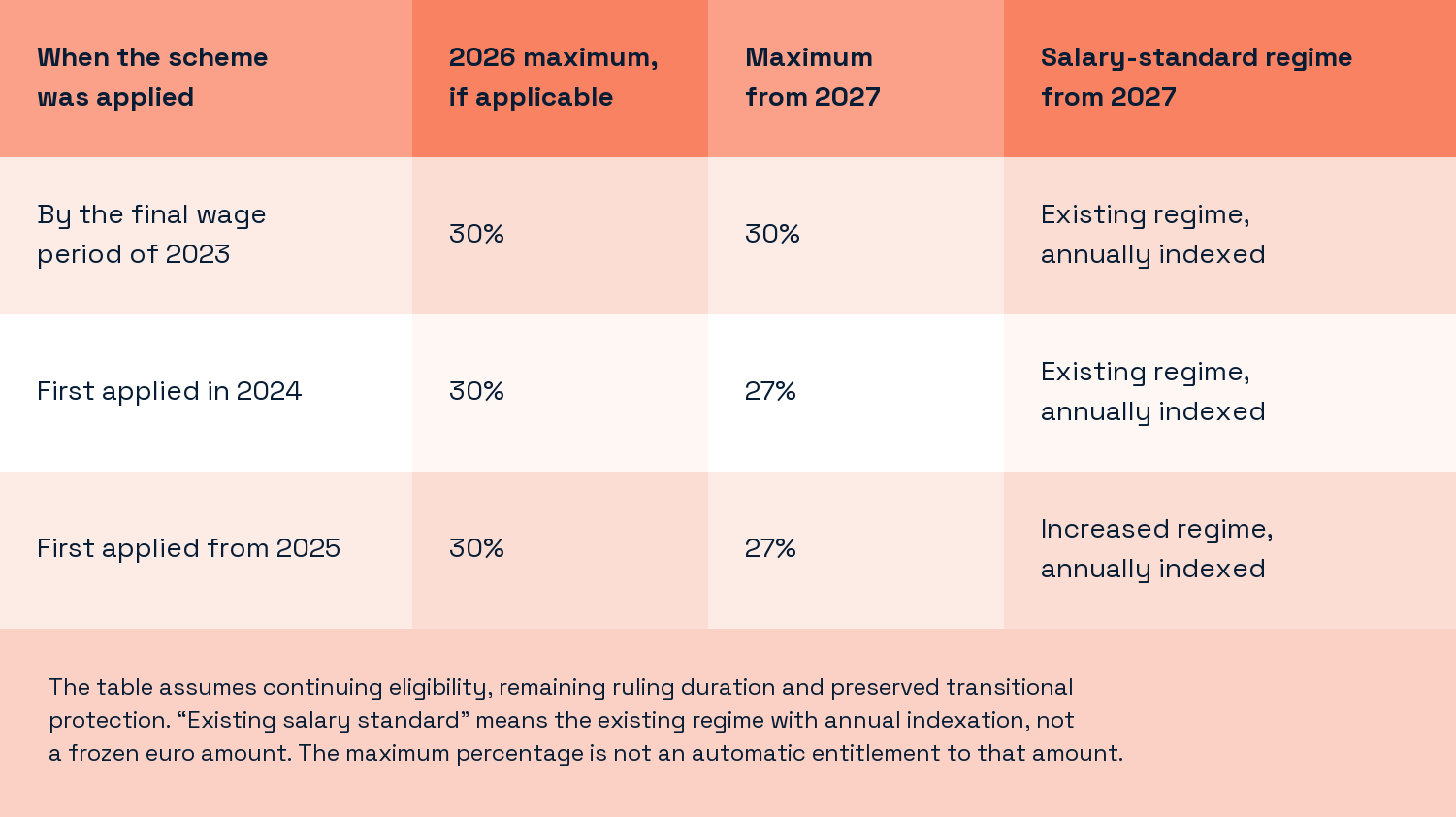
For the pre-2024 protection, the scheme must have been applied by the last wage period of 2023. For the 2024 salary-standard protection, check that the decision was valid in 2024 and the scheme was applied no later than the final wage period of that year. If the decision arrived later or payroll was corrected retrospectively, have payroll establish how the official rules apply to those records rather than classifying the employee from the letter’s date.
A change of employer does not automatically remove transitional protection. A qualifying continuation under the employer-change rules can preserve it; an interruption that creates a new incoming-employee situation can affect the result. Ask payroll to document that continuity before deciding which transitional rules apply. It is also worth noting that moving to 27% does not restart the ruling’s maximum five-year duration.
What salary requirements apply to the expat scheme in 2027?
The salary test concerns taxable pay excluding the tax-free allowance. A €70,000 package is therefore not necessarily €70,000 of salary for this test. Payroll must first establish the taxable portion and then compare it with the applicable annual standard.
For reference, the 2026 general standard requires taxable annual salary of more than €48,013. The reduced standard is more than €36,497 for qualifying employees under 30 with a Dutch academic master’s degree or an equivalent foreign qualification. These are 2026 figures, not confirmed 2027 thresholds. Designated scientific researchers and doctors training as medical specialists have exceptions to the salary standard.
In 2027, employees protected by the pre-2024 or 2024 transitional rules stay within the existing, annually indexed salary-standard regime. Employees entering from 2025 fall under the increased regime. The final indexed amounts must be checked in the official 2027 guidance before payroll signs off an individual calculation.
If pay is close to the threshold, payroll should test whether a smaller tax-free allowance leaves sufficient taxable salary. Part-year employment, certain leave situations and turning 30 can change the assessment. A work-permit salary requirement is a separate test: the Immigration and Naturalisation Service (IND) thresholds do not determine eligibility for this tax allowance.
How could the move to 27% affect take-home pay?
Consider an employee in the 2024 transition group with a fixed annual cash package of €100,000, including the allowance. Assume full-year eligibility, sufficient taxable salary, the maximum allowance and no change to the package. Hold other tax parameters constant for this illustration.
At 30%, €30,000 is tax-free and €70,000 is taxable. At 27%, €27,000 is tax-free and €73,000 is taxable. The change puts an additional €3,000 into taxable pay. It does not mean €3,000 less take-home pay: the tax on that additional taxable amount determines the net effect, alongside the employee’s wider payroll position.
That is a three-percentage-point reduction in the allowance, not a guaranteed 3% fall in net salary. Nor can an exact 2027 net result be calculated from the percentage alone; the applicable tax bands, credits and payroll inputs must also be known.
The employment agreement matters just as much as the calculation. With a fixed total package, the division between taxable pay and allowance can change. A net-pay guarantee or a different contractual arrangement can shift the cost to the employer. Neither automatic employer compensation nor an automatic right to change employment terms follows from the tax amendment. HR should confirm what was agreed before payroll communicates a personal outcome.

What is the remuneration cap for the 2027 expat allowance?
The cap is a ceiling on the remuneration used to calculate the allowance, not a minimum salary requirement or a limit on what someone may earn. It follows the general maximum under the Dutch senior-public-sector remuneration rules, known as the WNT.
The published WNT maximum for 2027 is €273,000, compared with €262,000 in 2026. On a full-year €273,000 calculation basis, a 27% maximum produces an allowance ceiling of €73,710. For a qualifying employee retaining 30%, the corresponding ceiling is €81,900. Again, please note that these are the maximum allowances, not guaranteed tax savings.
These are full-year ceilings. If the scheme applies for only part of the year, payroll must reduce the relevant cap proportionately; after an employer change, it must also check how the applicable periods are allocated between employers. This calculation is separate from the protected percentage: retaining 30% does not give an employee a full-year allowance for a shorter period or exempt them from the cap.
Does partial non-resident tax treatment also end in 2027?
Yes. Partial non-resident taxpayer treatment was abolished from the start of 2025, with qualifying transitional use available through 2026. Retaining a 30% payroll allowance does not extend that separate treatment into 2027.
Partial non-resident taxpayer treatment lets a qualifying employee living in the Netherlands be treated as a non-resident for two parts of the Dutch personal income-tax return. These are Box 2, which covers income from substantial shareholdings, and Box 3, which covers savings and investments. The treatment can limit the assets and income brought into those parts of the Dutch tax assessment. Employees using the transition should review their personal position with a tax adviser before it ends, because the impact depends on their assets, residence and applicable tax rules—not simply their monthly payslip.
What should employees prepare before the 2027 ruling changes?
Bring the following to the payroll discussion. The aim is to confirm which transitional rules apply to you and obtain a calculation based on the same compensation agreement as your employer’s records.
The ruling decision and its effective and end dates, plus any continuation decisions after an employer change. These establish the period that still remains.
Payslips from the relevant first and year-end wage periods. Ask payroll to confirm when the scheme was applied and whether corrections affect the transition assessment.
The offer, employment contract and allowance agreement. Identify whether the agreed amount includes the allowance and whether a net-pay commitment exists.
A request for a 2027 illustration showing the percentage, salary-standard regime, taxable pay and cap separately. Ask which official figures are final and when any provisional calculation will be refreshed.
Employees relying on partial non-resident treatment should arrange the personal-tax review separately. That issue will not be settled merely by confirming the 2027 allowance on a payslip.
How should employers prepare payroll for the 2027 expat scheme?
HR and payroll can establish the facts now, even where the final indexed salary amounts still need checking. Assign one person to keep the employee file, contractual review and payroll instructions aligned.
Build an affected-employee list with decision dates, effective periods, actual application history, remaining duration and evidenced transition group. Resolve missing old payslips or transfer records before setting a percentage.
Review the compensation agreement with HR. Confirm the treatment of the allowance and any net guarantee, and identify cases requiring employment-law or tax advice before changing terms.
Prepare the salary test using expected taxable pay, relevant bonuses, age and qualification status, and any part-year or leave adjustments. Keep the final 2027 thresholds as an explicit verification item.
Update and test payroll settings for the correct percentage, salary regime and cap. Compare a test payslip with the agreed package; investigate differences before approving the first affected run.
Explain the individual result to the employee, including the assumptions, unresolved inputs and contact person. When official figures or personal circumstances change, update both the calculation and the explanation.
A review during the final quarter of 2026 and a second check before the first affected 2027 payroll are sensible internal milestones, not new statutory filing deadlines. Existing ruling holders do not have to reapply solely because the percentage changes. The practical priority is therefore to complete the supporting records and turn them into clear, checked payroll instructions.
Prepare your 2027 ruling review with Unusual Payroll
A payroll provider can help turn this review into a working payroll instruction: bring together the ruling and historical payslips, identify missing records, check the agreed compensation basis and test the resulting payslip. Where an Employer of Record (EOR) acts as the legal employer, that provider also needs to coordinate the employment agreement with payroll. These roles should be clear before the first affected run; neither arrangement changes the tax conditions or creates transitional protection.
Unusual Payroll supports the preparation of 30% ruling information and coordination between employer and employee. Contact Unusual Payroll with your decision, relevant payslips and compensation agreement to discuss the support you need. Personal investment-tax questions and contractual issues requiring specialist advice should be identified separately.
Is the old 30/20/10 schedule still the rule for 2027?
No. The Belastingplan 2025 replaced that phased schedule. Use the applicable 2027 transition group and remaining ruling period rather than a calculation based on successive 30%, 20% and 10% stages.
Does moving to an Employer of Record preserve a 30% rate automatically?
No. An Employer of Record is a provider acting as the legal employer; that arrangement does not create transitional protection or restore an expired ruling. Any continuation must meet the tax rules and be supported by the employment and payroll records.
Can the allowance always be increased to the legal maximum?
No. The legal maximum is a ceiling. The agreed arrangement, taxable-salary requirement, remuneration cap and remaining period can limit what is actually paid tax-free.
Does a ruling approval also give me permission to work in the Netherlands?
No. Tax treatment and immigration permission are separate. An employee and employer must meet any applicable residence and work-authorisation requirements independently.